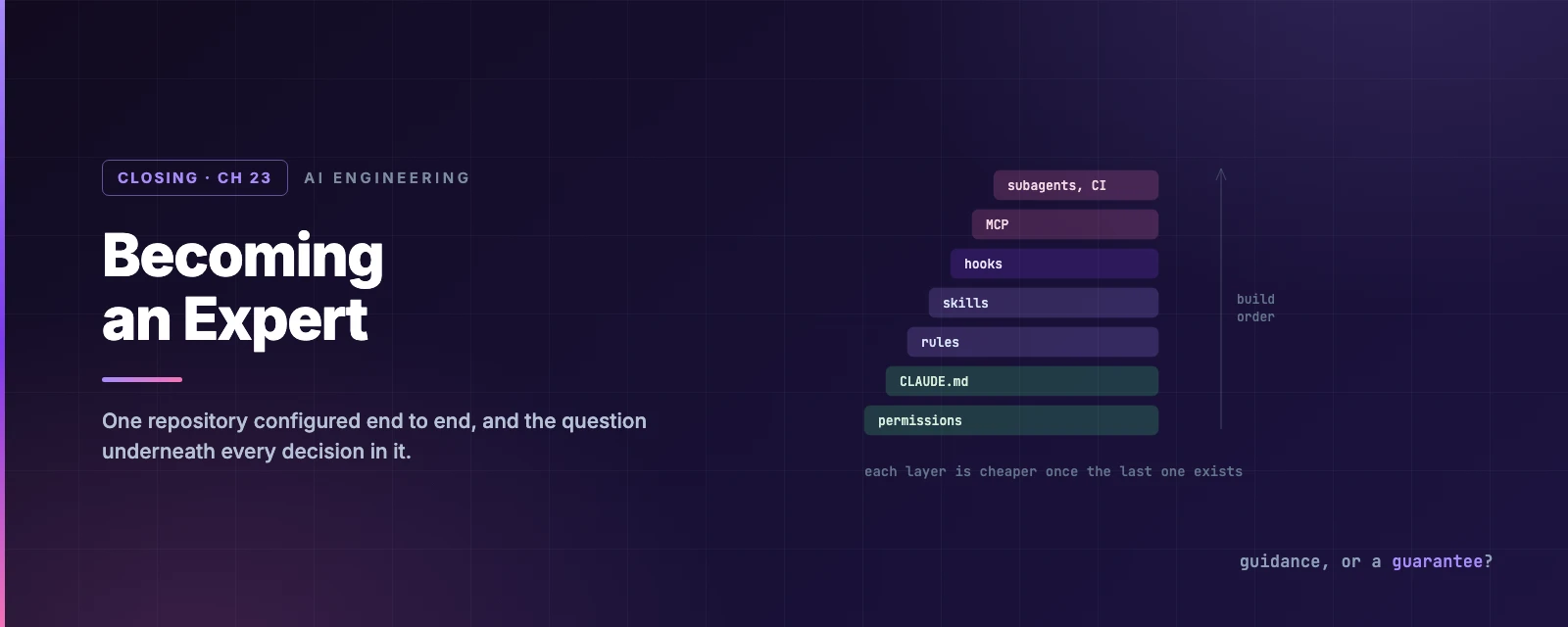
Becoming an Expert
Overview
This chapter covers:
- One repository configured end to end, in the order that makes each layer cheap
- The single question underneath nearly every decision in this handbook
- The habits that separate people who use Claude Code from people who are good at it
- A checklist to audit what you have actually set up
- Where the road continues once the CLI stops being enough
The build order
Configuring a repository is not a list of files to create. It is a sequence, and the sequence matters — each layer is cheaper once the one before it exists. Writing skills before you have a CLAUDE.md means writing the project’s conventions into every skill.
flowchart TB
    A[Safety: permissions] --> B[Context: CLAUDE.md]
    B --> C[Scope: rules]
    C --> D[Capability: skills]
    D --> E[Guarantees: hooks]
    E --> F[Reach: MCP]
    F --> G[Scale: subagents, CI]
| Step | What to do |
|---|---|
| 1. Safety | Pick a permission mode deliberately, and add deny rules for secrets and infrastructure before anything runs unattended — Ch 3, Ch 4 |
| 2. Context | /init, then delete everything Claude could work out by reading the code. Under 200 lines — Ch 6 |
| 3. Scope | Anything that applies to one directory becomes a rule with paths:, not a paragraph everyone pays for — Ch 7 |
| 4. Capability | The third time you paste the same instructions, they are a skill — Ch 11 |
| 5. Guarantees | What must never happen stops being an instruction and becomes an exit code — Ch 12 |
| 6. Reach | An MCP server only where a CLI tool cannot do the job; every server costs window before it earns any — Ch 14, Ch 15 |
| 7. Scale | Subagents for verbose work, CI for the unattended kind — Ch 16, Ch 17 |
Two orderings people get wrong. Permissions come first, not last — they are the layer you regret configuring after the fact. And hooks come after skills, because the point of writing something down first is finding out whether guidance was enough.
The question underneath everything
If you keep one thing from twenty-three chapters, keep this. Almost every configuration decision in Claude Code is the same question wearing different clothes:
Do you need guidance, or a guarantee?
Guidance is context: CLAUDE.md, rules, skills, output styles. Claude reads it, weighs it against everything else in the window, and usually follows it. Usually.
A guarantee is enforcement: permission rules, hooks, the sandbox. Claude’s opinion is not consulted. A PreToolUse hook returning exit code 2 stops the tool call whether or not Claude agrees.
The failure mode is always the same direction — writing a guarantee into a file that only offers guidance:
| You wrote | Where it belongs |
|---|---|
“Never commit directly to main” in CLAUDE.md | A PreToolUse hook |
| “Don’t touch the migrations directory” | A deny rule |
| “Always run the linter before committing” | A hook, if it truly is always |
| “We use tabs, not spaces” | CLAUDE.md — this one is genuinely guidance |
Ask it of every line you write into a config file, and most of this handbook’s advice falls out on its own.
What experts actually do differently
Less configuration than you would expect. Mostly it is a handful of reflexes.
Plan before anything non-trivial. Shift+Tab into plan mode. Reading and planning cost a fraction of what rework costs, and a wrong approach found in the plan is free.
/clear between unrelated tasks. The single largest lever on both quality and cost. Stale context does not just cost money, it actively misleads.
Correct instead of re-prompting. When Claude goes the wrong way, say so in the same session — the context from the failed attempt is what makes the correction land. Starting over throws that away.
Steer without stopping. Esc cancels the running tool call. Typing while it works does not interrupt anything; the text is read before the next action is chosen. Most people only know the first.
Delegate anything verbose. Test output, log spelunking, doc trawling — a subagent’s window absorbs it and yours never sees it.
Look, don’t reason. When something is not taking effect, /context and /permissions show you what actually loaded. Every minute spent theorising about why a file is not working is a minute you could have spent reading the answer.
And one that is really a mindset: specify the target and the symptom, not the procedure. “The checkout flow fails for expired cards, relevant code is in src/payments/” beats a prescribed sequence of steps, because a prescription bakes in your assumption about where the bug is — and if that assumption is wrong, it sends Claude away from the actual problem.
Audit what you have
Work down this. Anything you cannot tick is a chapter worth revisiting.
Where this goes next
At some point the CLI stops being the right shape. Not because it runs out of features, but because what you want is not a session — it’s an application: something triggered by a webhook, running for a customer, with its own interface.
That is the Agent SDK: the same agent loop, the same tools and the same context management, as a library in Python or TypeScript. Everything in this handbook carries over — hooks, subagents, MCP, permissions, sessions — and skills, commands and memory still load from .claude/ and ~/.claude/ exactly as they do here.
Four things sit next to each other, and the choice is genuinely about what you are doing rather than how advanced you are:
| If you are | Use |
|---|---|
| Working interactively, or scripting one-off tasks | The CLI |
| Building an agent, without writing the tool loop yourself | The Agent SDK |
| Calling the API and writing your own loop | The Client SDK |
| Running long jobs without operating a sandbox | Managed Agents |
Two practical notes. The SDK is Python and TypeScript only — from any other language, run the CLI as a subprocess with -p and --output-format json, which is Chapter 2’s print mode doing exactly what it was built for. And products built on the SDK authenticate with API keys, not claude.ai logins.
Where to keep reading
- The official documentation — the authority. This handbook teaches the concepts; the docs hold the complete reference for every one of them.
- The changelog — this tool moves fast enough that a habit formed six months ago may already have a better answer.
- Claude itself. It has its documentation built in. “How do I scope a rule to one directory?” is often faster asked than searched.
And the one nobody suggests: read your own ~/.claude/settings.json every few months. Configuration accumulates. Half of what is in there was for a problem you no longer have.
Summary
- Build in order: permissions, context, scope, capability, guarantees, reach, scale. Each layer is cheaper once the one before it exists.
- The recurring question is guidance or guarantee —
CLAUDE.mdfor how the project works, permissions and hooks for what must never happen. - The habits matter more than the configuration: plan first,
/clearbetween tasks, correct rather than restart, delegate verbose work, and look at what loaded instead of reasoning about it. - Specify the target and the symptom. Leave the procedure to Claude.
- When you need an application rather than a session, the Agent SDK is the same loop as a library — and your
.claude/directory comes with it.
That’s the handbook. Twenty-three chapters, from a model that cannot read files to a repository that configures itself for you.
The tool will keep changing. The question underneath it — guidance, or guarantee? — will not.