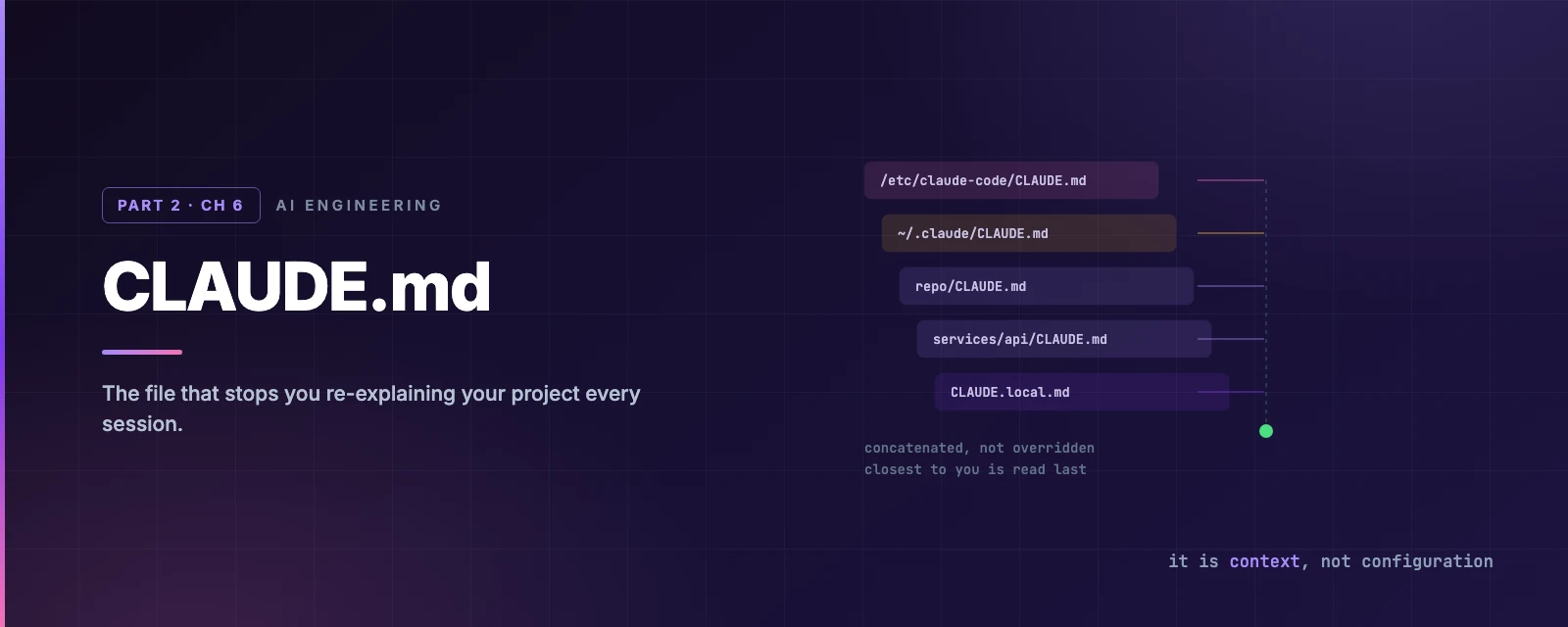
CLAUDE.md
Overview
This chapter covers:
- The trigger for writing something down: you typed the same correction twice
- Every location a
CLAUDE.mdcan live, and how several of them combine rather than override @pathimports, the four-hop limit, and the approval dialog that guards them- Why “context, not configuration” is the property that explains every troubleshooting step
- The test that decides whether an instruction belongs in
CLAUDE.md, a rule, a skill, or a hook
The problem it solves
Every session starts with an empty context window. Whatever you explained yesterday — that the build is pnpm, that API handlers live in src/api/handlers/, that the integration tests need Redis running — is gone.
CLAUDE.md is the file you write once and Claude reads at the start of every session. The useful trigger for adding to it is behavioural rather than architectural:
- Claude made the same mistake a second time.
- You typed a correction you also typed last session.
- A review caught something Claude should have known about this codebase.
- A new teammate would need the same context to be productive.
That last one is the sharpest test, because it also tells you what to leave out. A new teammate can read your directory structure; they cannot guess that you deploy from release/* and never from main.
Where it lives
Four scopes, listed in load order — broadest first, so the most specific instruction lands last:
| Scope | Location | Shared with |
|---|---|---|
| Managed policy | /Library/Application Support/ClaudeCode/CLAUDE.md (macOS), /etc/claude-code/CLAUDE.md (Linux, WSL) | Everyone in the organisation |
| User | ~/.claude/CLAUDE.md | Just you, every project |
| Project | ./CLAUDE.md or ./.claude/CLAUDE.md | Your team, through source control |
| Local | ./CLAUDE.local.md | Just you, this project — gitignore it |
An organisation can also put the content directly in managed-settings.json under claudeMd, and a managed file cannot be excluded by any personal setting.
Several files, concatenated
This is the part that behaves differently from settings. In Chapter 5 the highest scope won. Here nothing overrides anything — every discovered file is concatenated into context.
flowchart TB
    A["/etc/claude-code/CLAUDE.md — managed"] --> B["~/.claude/CLAUDE.md — you"]
    B --> C["monorepo/CLAUDE.md — repo root"]
    C --> D["monorepo/services/api/CLAUDE.md — where you launched"]
    D --> E["CLAUDE.local.md — your private notes"]
    E --> F(["All of it, in this order"])
Claude Code walks from your working directory up through every parent, then orders the content root-first, so instructions closest to where you launched are read last. Within a directory, CLAUDE.local.md is appended after CLAUDE.md.
Two consequences:
- Contradictions are not resolved for you. If a parent file says 4-space indent and yours says 2, Claude may pick either. Periodically re-read what actually loads.
- Subdirectory files load on demand, not at launch. A
CLAUDE.mdinsrc/payments/enters context when Claude reads a file there.
In a monorepo where other teams’ files get swept up, claudeMdExcludes skips them by glob. Put it in .claude/settings.local.json so the exclusion stays yours:
{
  "claudeMdExcludes": ["**/monorepo/other-team/**"]
}
/context is how you check what actually loaded — the Memory files list. /memory opens any of them for editing, including ones that don’t exist yet.
Imports
@path/to/file pulls another file in. Relative paths resolve against the file containing the import, not your working directory, and imports can nest four hops deep.
See @README for the project overview and @package.json for the npm scripts.

- git workflow @docs/git-instructions.md
Two details that bite:
- Import parsing skips code spans and fenced blocks. To write
@READMEwithout importing it, put it in backticks. - An import that resolves outside your working directory triggers an approval dialog, once, listing the files. That guard exists because a project file is something other people commit. Imports in your own user-scope files are trusted without it.
Imports do not save context. The imported file is expanded and loaded at launch exactly as if you had pasted it. Splitting a large CLAUDE.md into imports buys organisation, not tokens. Path-scoped rules — Chapter 7 — are what actually reduce what loads.
If your repo already has AGENTS.md
Claude Code reads CLAUDE.md, not AGENTS.md. Import it rather than duplicating it, and put Claude-specific additions underneath:
@AGENTS.md

## Claude Code

Use plan mode for changes under `src/billing/`.
A symlink works too if you need nothing extra — though on Windows that requires Administrator or Developer Mode, so prefer the import. /init also reads Cursor and Copilot rule files and folds the relevant parts in.
Writing instructions that land
CLAUDE.md is delivered as a user message after the system prompt. It is context, not enforced configuration — Claude reads it and tries to comply, and that is the whole ballgame. Every piece of advice below follows from that one fact.
Size. Target under 200 lines. Longer files consume more context and reduce adherence — the second effect is the one people miss. Claude Code loads a file up to 4 MiB and skips anything larger, but nothing about that limit is a target.
Specificity. Write what you could verify:
| Instead of | Write |
|---|---|
| “Format code properly” | “Use 2-space indentation” |
| “Test your changes” | “Run npm test before committing” |
| “Keep files organised” | “API handlers live in src/api/handlers/” |
Structure. Headers and bullets. Claude scans structure the way you do; a dense paragraph is harder to follow than a grouped list.
Emphasis, sparingly. Marking a rule IMPORTANT or YOU MUST does measurably improve adherence — which is exactly why it stops working if you mark everything. Spend it on the two or three rules whose violation would actually cost you.
Never put a secret in it
CLAUDE.md is loaded into context every session and, at project scope, committed to your repository. Two categories do not belong in it:
- Credentials, API keys, tokens. Beyond the obvious, this file is designed to be read aloud into a model’s context on every run. There is no scenario where a secret in it is contained.
- Rules a linter already enforces. ESLint, Prettier and Checkstyle enforce;
CLAUDE.mdonly asks. Duplicating them spends context and adherence budget on something already guaranteed elsewhere.
One small mechanic worth knowing: block-level HTML comments are stripped before the content reaches context. <!-- maintainer note --> costs you nothing, so notes to human maintainers are free.
Where does this instruction belong?
CLAUDE.md is one of four mechanisms, and putting an instruction in the wrong one is the most common reason it doesn’t take.
Generating and maintaining it
/init analyses your codebase and writes a starting file — build commands, test instructions, discovered conventions. If one already exists it proposes improvements rather than overwriting. Set CLAUDE_CODE_NEW_INIT=1 for an interactive flow that explores with a subagent, asks follow-up questions, and shows you a proposal before writing anything.
Then refine it with what /init cannot discover. A generated file describes your repository; the valuable half is the part that contradicts what the code implies.
/doctor proposes trims for a checked-in CLAUDE.md, and its heuristic is the right one to internalise: cut what Claude can derive from the codebase — directory layouts, dependency lists, architecture overviews — and keep pitfalls, rationale, and conventions that differ from tool defaults.
When it isn’t being followed
In order:
- Run
/context. If the file is not under Memory files, Claude cannot see it, and nothing else you try matters. - Check the location is one that loads for where you launched the session.
- Make it specific. Vague instructions are followed vaguely.
- Look for a contradiction across parent files, nested files and rules.
Two symptoms point at specific causes rather than the list above. If Claude keeps ignoring one rule, the file is probably too long and that rule is buried — trim, or mark it. If Claude keeps asking about something the file already answers, the phrasing is ambiguous rather than missing; rewrite it as something you could verify.
If none of that fixes it, the instruction may be in the wrong mechanism. Something that must happen at a specific moment — before every commit, after each edit — is a hook, because hooks run regardless of what Claude decides. For system-prompt-level instruction there is --append-system-prompt, though it must be passed every invocation, which suits scripts rather than interactive work.
Debugging tip: the
InstructionsLoadedhook logs exactly which instruction files loaded, when, and why. It is the only way to see path-scoped and lazily-loaded files resolve in real time.
After /compact
A project-root CLAUDE.md survives compaction — Claude re-reads it from disk and re-injects it. Nested files and path-scoped rules reload as Claude touches matching files again.
So if an instruction vanished after a compact, it was almost certainly given in conversation only. That is the signal to write it down.
Summary
- Write to
CLAUDE.mdwhen you correct the same thing twice, not when you think of something. - Four scopes — managed, user, project, local — and unlike settings, they concatenate rather than override, ordered root-first with
CLAUDE.local.mdlast. - Subdirectory files load on demand when Claude reads files there.
@pathimports nest four deep, skip backticked text, and prompt once for anything resolving outside the working directory. They do not reduce context.- It is context, not configuration. Under 200 lines, specific enough to verify, structured. HTML comments are free.
IMPORTANTandYOU MUSTimprove adherence — and stop working if you mark everything.- Never a secret, and never a rule your linter already enforces.
- Cut what Claude can derive from the code; keep what contradicts the defaults.
/contextsays what loaded,/memoryedits it,/initgenerates it,/doctortrims it.- An instruction that must fire at a fixed moment is a hook, not a line in this file.
- Full reference: memory, the
.claudedirectory.
Chapter 7 covers the two mechanisms this one kept deferring to: .claude/rules/ for instructions scoped to paths, and auto memory — the notes Claude writes for itself.